

A single AI model simulates the behavior of many substances, from sliding sand to folding proteins

What happened
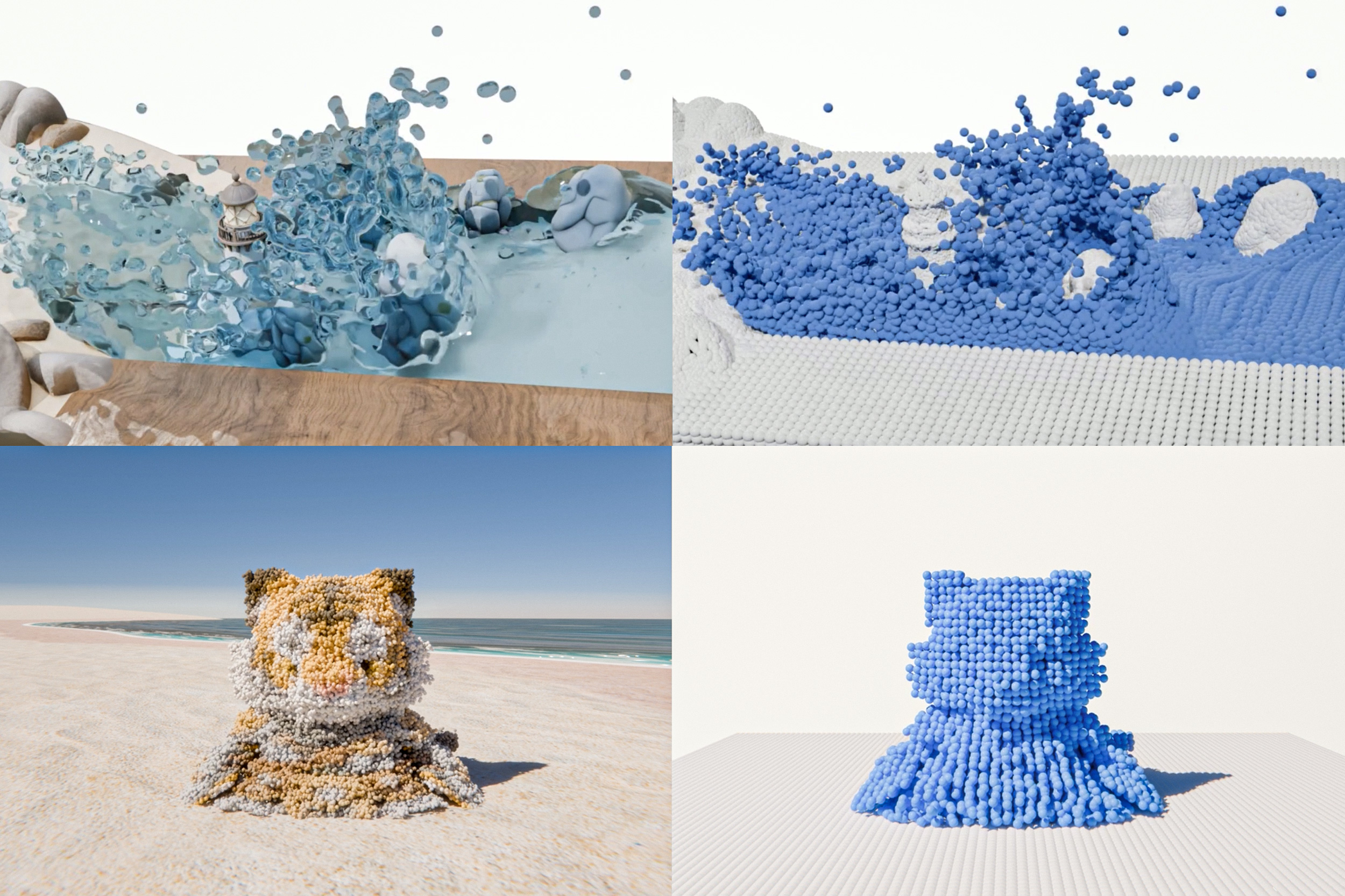
A team of researchers from MIT, the University of British Columbia, and other institutions created WorldParticle, an AI model that simulates the behavior of different materials by predicting the movement of particles. The model does not rely on predefined equations but instead learns the dynamics of materials directly. WorldParticle was demonstrated on six types of physical phenomena, including sand, deformable objects, and proteins. The research will be presented at the ACM SIGGRAPH Asia conference.
Key details
- WorldParticle uses a neural network to predict the positions and properties of particles in three dimensions.
- The model can handle materials and forces it was not trained on.
- WorldParticle simulated protein structure changes about 100 times faster than traditional numerical simulators.
- The system can compress and merge particles to reduce computational demands while maintaining detail.
- Researchers involved are from MIT, UBC, Georgia Tech, Inria, Meta, and several other institutions.
Why it matters
Scientists and engineers who need to simulate physical processes can now use a single AI model instead of building separate simulators for each material or phenomenon. This reduces the time and effort required to model new materials or environments and enables faster simulations, such as protein folding, which can accelerate research in fields like material science and biology. The ability to generalize to new conditions means researchers can study scenarios that were previously too complex or time-consuming to simulate.