

Baidu’s ERNIE Evolve Automated Research System Beats NanoChat and NanoGPT Records

What happened
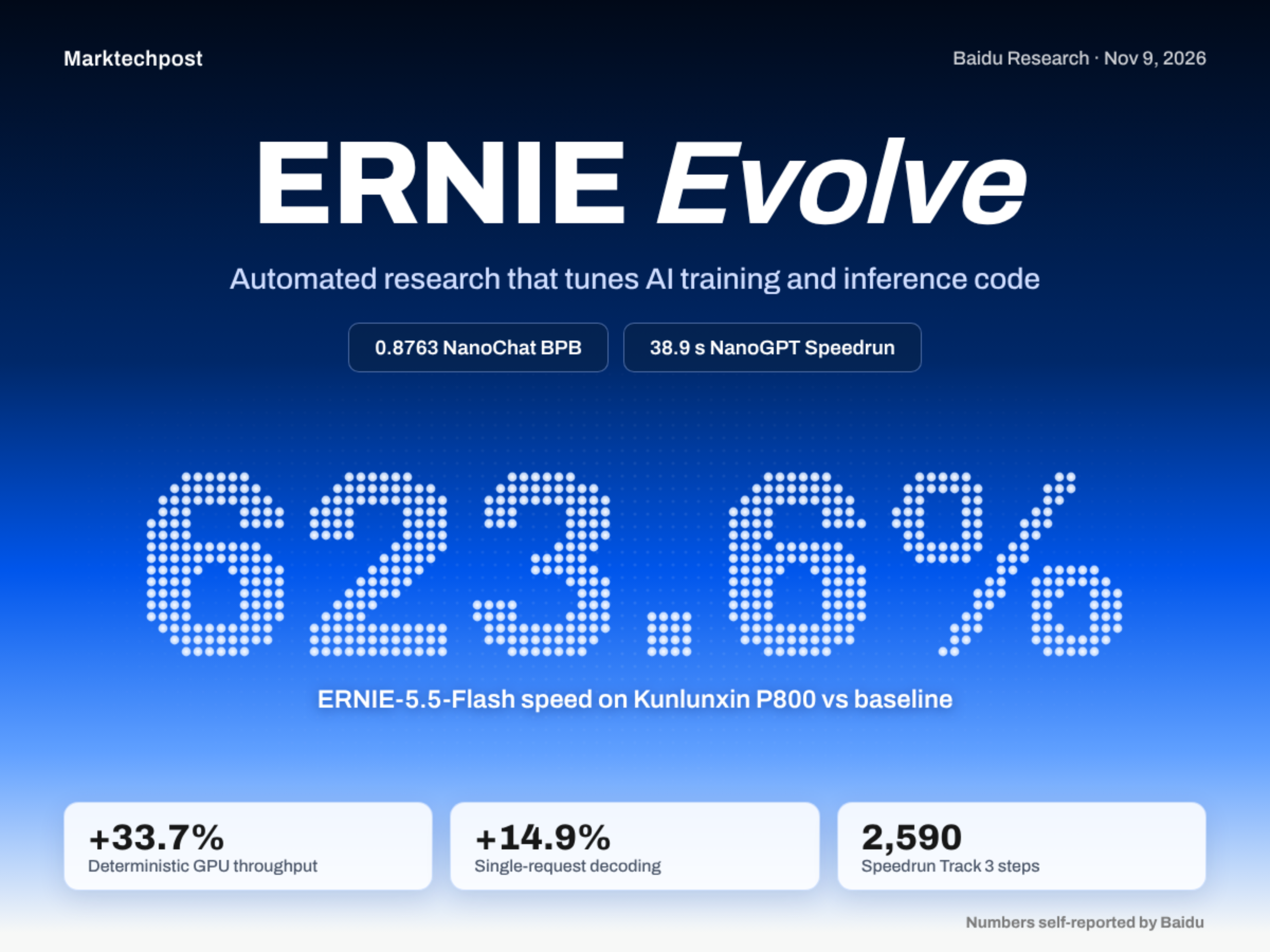
Baidu introduced ERNIE Evolve, an automated research system designed to enhance AI training and inference code. The system selects research directions, edits code, and runs experiments, keeping only improvements that pass evaluation and review. Baidu tested ERNIE Evolve on three public benchmarks and used it to optimize the ERNIE-5.5-Flash model, which is still under development. In production tests, ERNIE Evolve delivered significant improvements in inference speed and throughput.
Key details
- ERNIE Evolve beat the best public results on three out of four public metrics, including NanoChat AutoResearch and NanoGPT Speedrun benchmarks.
- On the Kunlunxin P800 hardware, ERNIE-5.5-Flash generation speed increased to 623.6% of the baseline after four research rounds.
- Deterministic inference throughput for ERNIE-5.5-Flash rose by 33.7%, with a 26% reduction in time per output token.
- Single-request decoding speed on GPUs improved by 14.9% without loss of accuracy.
- The system remains closed-source; only results and logs are available on GitHub.
Why it matters
AI developers and companies using Baidu’s ERNIE models gain access to faster and more efficient inference capabilities, reducing operational costs and improving user experience. Baidu’s internal teams can now automate code optimization for AI models, speeding up development cycles and potentially lowering the need for manual engineering. The improvements in ERNIE-5.5-Flash’s performance mean that production deployments can handle more requests with lower latency, directly benefiting applications that rely on real-time AI responses.