

NVIDIA Introduces GR00T 2 for Robots Learning From Human Video

What happened
NVIDIA announced the GR00T 2 model on November 9, 2026, at the Conference on Robot Learning in Austin. GR00T 2 is a 2-billion-parameter transformer trained on a large dataset of human video and robot demonstrations. The model achieved 40% zero-shot success on 50 tasks it had not seen during training and supports different robot types. NVIDIA also introduced Isaac Lab 3.0, a simulation platform designed to improve training for dexterous manipulation tasks.
Key details
- GR00T 2 is built on the Cosmos-Predict2.5-2B architecture.
- Pretraining used 402,730 hours of human video, 10,184 hours of handheld-gripper demonstrations, and 23,500 hours of robot teleoperation.
- The Human-1M-100K dataset release includes 100,000 hours of human video and motion data under a CC BY 4.0 license.
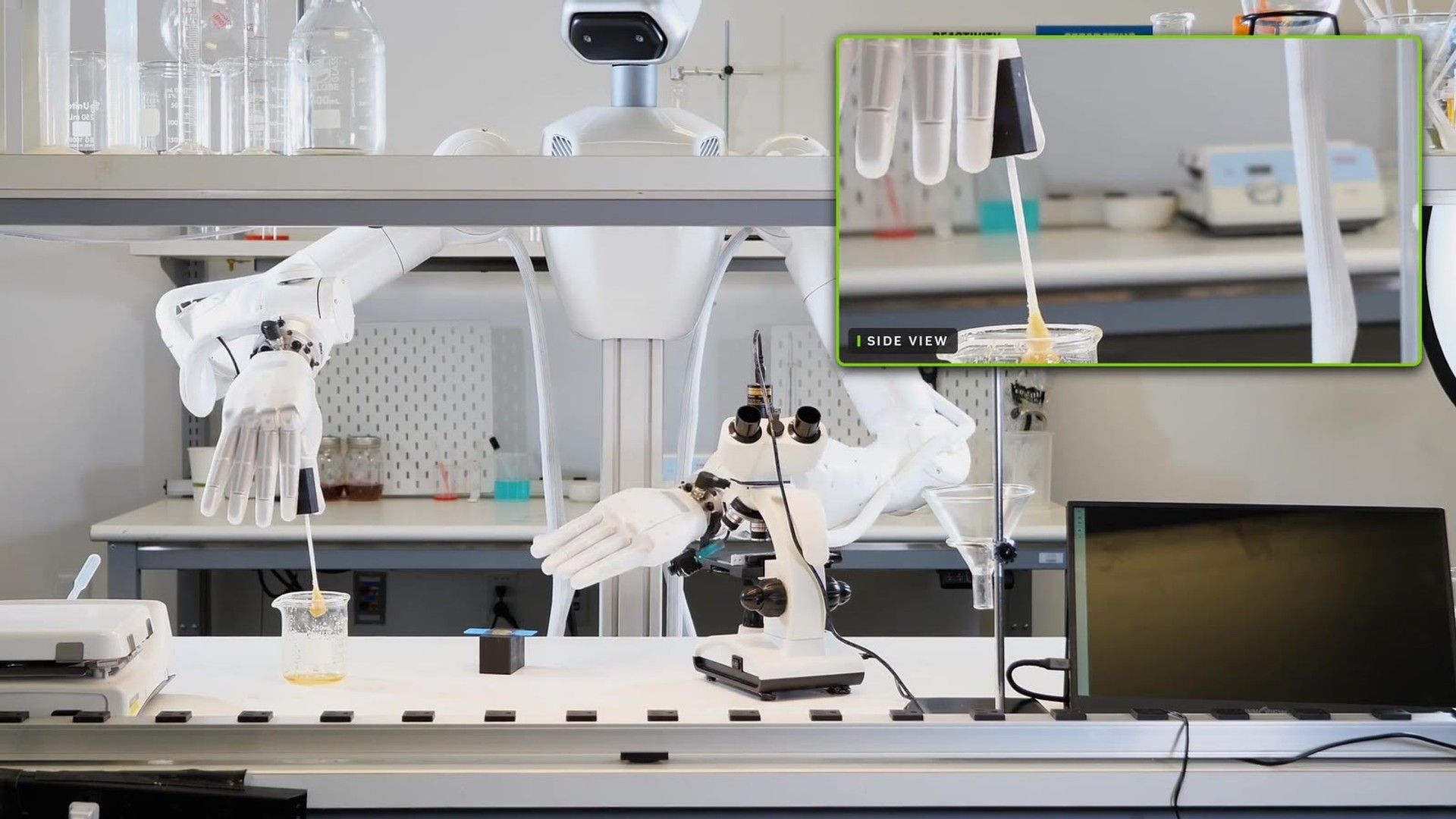
- GR00T 2 achieved 65% success on filter-paper setup and 60% on toy dump-truck assembly in cross-embodiment tests.
- Code for GR00T 2 is planned for release in December 2026.
Why it matters
Robotics researchers and companies testing automation can now access a model that learns from both human and robot data, with demonstrated ability to transfer skills between different robot types. Industrial users evaluating GR00T 2 face new options for adapting robots to complex tasks with less fine-tuning data and can use open datasets for further development. The planned code release and open datasets lower barriers for research and commercial use, but users must still address adaptation time and agent oversight costs documented in NVIDIA's results.